What happens in a CPR training course?
What to bring, what you practise and what you get from HLTAID009 CPR training in Sydney, plus how to ask about CPR Melbourne dates.
Written byEdway
The short answer
Learning CPR is truly life-saving knowledge. A CPR course is a short, hands-on class where you learn and practise cardiopulmonary resuscitation (CPR) on a manikin. The course is HLTAID009 Provide cardiopulmonary resuscitation. It takes about 3 hours in a classroom, after a short online module. Training Aid Australia (RTO 91411) delivers and issues the CPR training course in Sydney and Melbourne.
You never know when an emergency can occur. A friend, a workmate or a complete stranger could collapse in front of you. CPR certification gives you the skills and the confidence to step in and help.
Before you book
Three things to know before you book CPR training.
- Bring ID and your USI. You need one photo ID and your Unique Student Identifier (USI) to enrol.
- You will kneel on the floor. To pass, you must do 2 minutes of uninterrupted CPR on a manikin on the floor. If you have an injury or condition that makes this hard, contact the issuing RTO before you book.
- Complete the online module first. There is a compulsory online module to finish before your classroom session. You also need enough English to follow the course.
That is how to get CPR certified: enrol, finish the online module, then show your skills in class.
What you practise
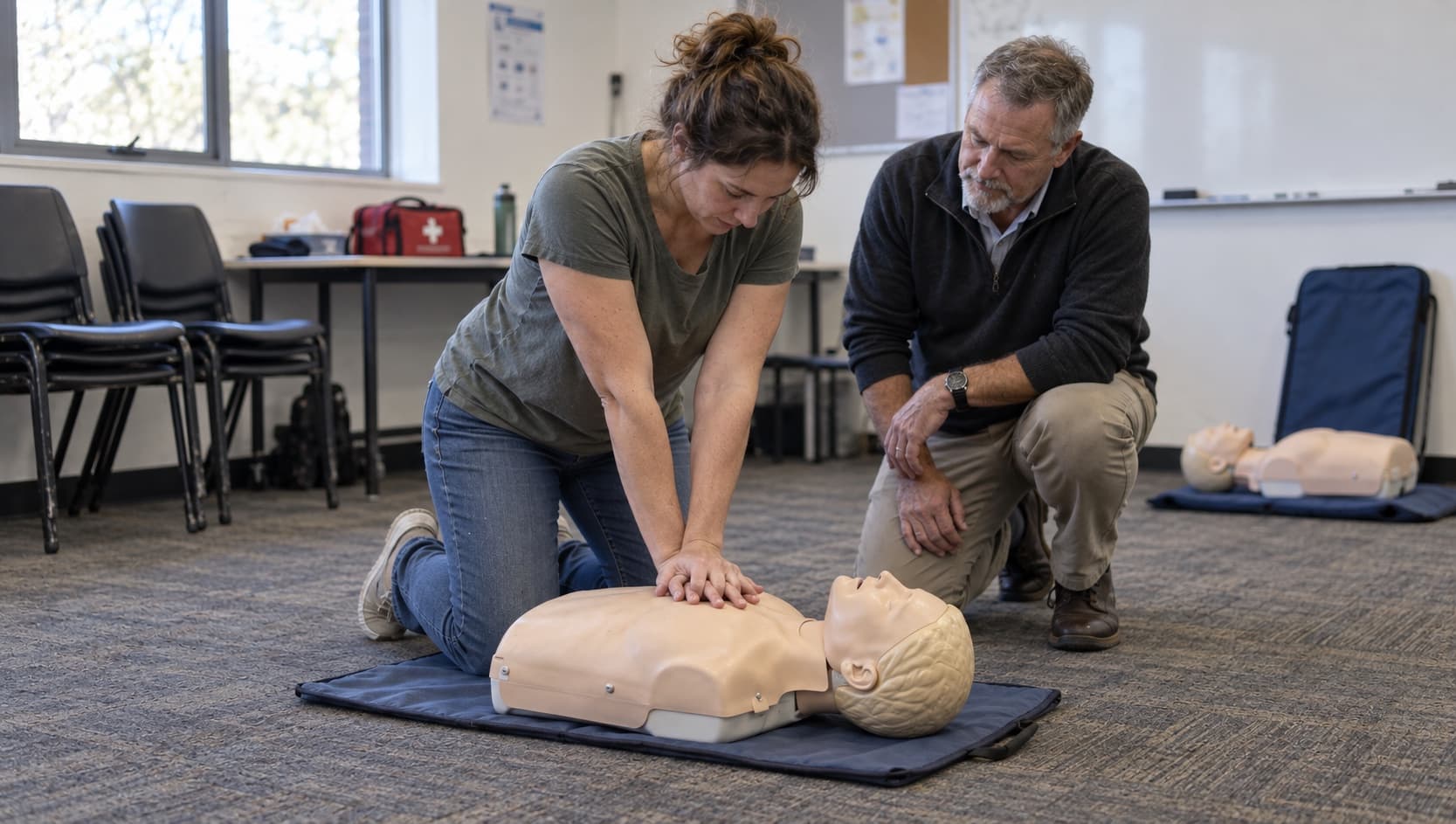
Understanding the theory behind CPR is important, but being able to perform it in a real-life situation is what counts. That is why the course is practical. In class, you practise:
- recognising when a person is unconscious
- giving CPR to current Australian Resuscitation Council (ARC) guidelines
- placing a person in the recovery position
- responding to a blocked airway
- protecting yourself and lowering the risk of infection while you help
Most of the time is spent on the floor with a manikin, so wear comfortable clothes.
You also practise with a training defibrillator (AED), following its voice prompts to deliver a shock on the manikin. This is part of the unit's assessment, so every CPR course includes it.
Your trainer is there to help. If there are steps that are unclear to you, ask the trainer so they can address it right away. This way, you will be confident when the time comes that you need to perform CPR.
Learning CPR to look after an older relative
If you care for an older parent, partner or relative, you've probably wondered what you would do if they collapsed at home. A CPR course means you would know what to do. You would also have done it before, on a manikin, with a trainer checking your technique.
Is CPR different for older people?
No. The Australian and New Zealand resuscitation guidelines (ANZCOR) use the same CPR for every adult, whatever their age:
- push on the lower half of the breastbone, about one third of the depth of the chest (more than 5 cm)
- push at 100 to 120 compressions a minute
- give 30 compressions, then 2 breaths.
Broken ribs and other injuries are common during CPR. The guidelines say that risk is acceptable, so don't hold back.
Start CPR if the person is unresponsive and not breathing normally. Keep going until they respond or start breathing normally, a health professional takes over, or you can't continue.
Why do the course, not just read the steps?
Reading the steps is a good start. But it is hard to know from a page how hard to push, or how fast. In the course you:
- practise compressions on an adult manikin until the depth and speed feel right
- use a training defibrillator (AED) and follow its voice prompts
- place a person in the recovery position
- ask your trainer about anything you're unsure of.
To pass, you do 2 minutes of CPR kneeling on the floor. If that would be hard for you, contact Training Aid Australia (RTO 91411) before you book.
Classes run in Sydney at Darlinghurst, Seven Hills and Mona Vale, and Melbourne is by enquiry. Check dates and book your seat on the CPR course page.
Four CPR myths
Most people like to think they know a little about CPR. Here are four myths to leave behind.
- "A CPR course is the same as first aid." The CPR course covers CPR only. The first aid course adds bleeding, burns, fractures, choking, asthma, anaphylaxis and more, and it includes the CPR unit.
- "A CPR course online gives the same certificate." A separate non-accredited online CPR course does not give you the HLTAID009 Statement of Attainment. This course needs you to show your CPR in person. The best way to learn CPR is still a course where you physically practise on a manikin.
- "Once you learn CPR, you are covered for life." Most workplaces ask you to refresh CPR every 12 months. A CPR refresher course keeps your skills sharp.
- "Helping is only about the casualty." The course also teaches you to protect yourself and lower the risk of infection while you give CPR.
How long it takes and what you receive
The classroom session is 3 hours including breaks. You also complete the compulsory online module before class.
When you pass, you receive a nationally recognised Statement of Attainment for HLTAID009. It is treated as current for 12 months, and most workplaces ask for a yearly refresh. For how this fits with first aid, read how long a first aid certificate lasts.
The price is on the course page. You can check the CPR course cost and book your seat in the same place.
CPR training Melbourne and Sydney
You can find and book CPR training through Edway. Training Aid Australia (RTO 91411) delivers and issues the course.
- Sydney: classroom sessions run at Darlinghurst, Seven Hills and Mona Vale. Dates are shown on the course page. It is a simple way to get your CPR certification in Sydney.
- CPR Melbourne: the course is offered by enquiry. Send an enquiry from the course page to ask about dates for your CPR certification in Melbourne.
The CPR course suits workers who need a yearly CPR update, parents and carers, fitness and aquatic staff, and anyone who wants to be ready to help. If you are planning a hiking trip or time outdoors, CPR is a useful skill to have. A hiking trip needs a few essentials like water and comfortable shoes, and CPR training is one more. It is knowledge you can use long after the trip. If you want to learn more than CPR, compare the options in which first aid course you need.
What makes a good CPR training course in Melbourne or Sydney?
Look for a course where you practise CPR on a manikin, not one where you only watch. The theory matters, but your hands need to learn the steps. A good course also gives you a trainer to ask, so nothing is left unclear on the day.
It should follow current Australian Resuscitation Council guidelines and end with a nationally recognised Statement of Attainment for HLTAID009. The CPR course ticks every box, with Sydney dates and Melbourne enquiries in one place.
Next step
Taking a CPR course will equip you with life-saving skills that could one day help you save a life. Check Sydney dates or send a Melbourne enquiry on the CPR course page.
Sources
- ANZCOR Guideline 6 — CompressionsSame compressions for every adult: lower half of the breastbone, one third of chest depth (over 5 cm), 100 to 120 a minute; rib injuries an acceptable risk
- ANZCOR Guideline 8 — Cardiopulmonary Resuscitation (CPR)When to start CPR, 30:2, when to stop