
Fire warden or chief fire warden — which course does your workplace need?
One trains the wardens who carry out an evacuation, the other trains the person who leads it. Here is what each covers, and where extinguisher training fits.
Written byEdway
The short answer
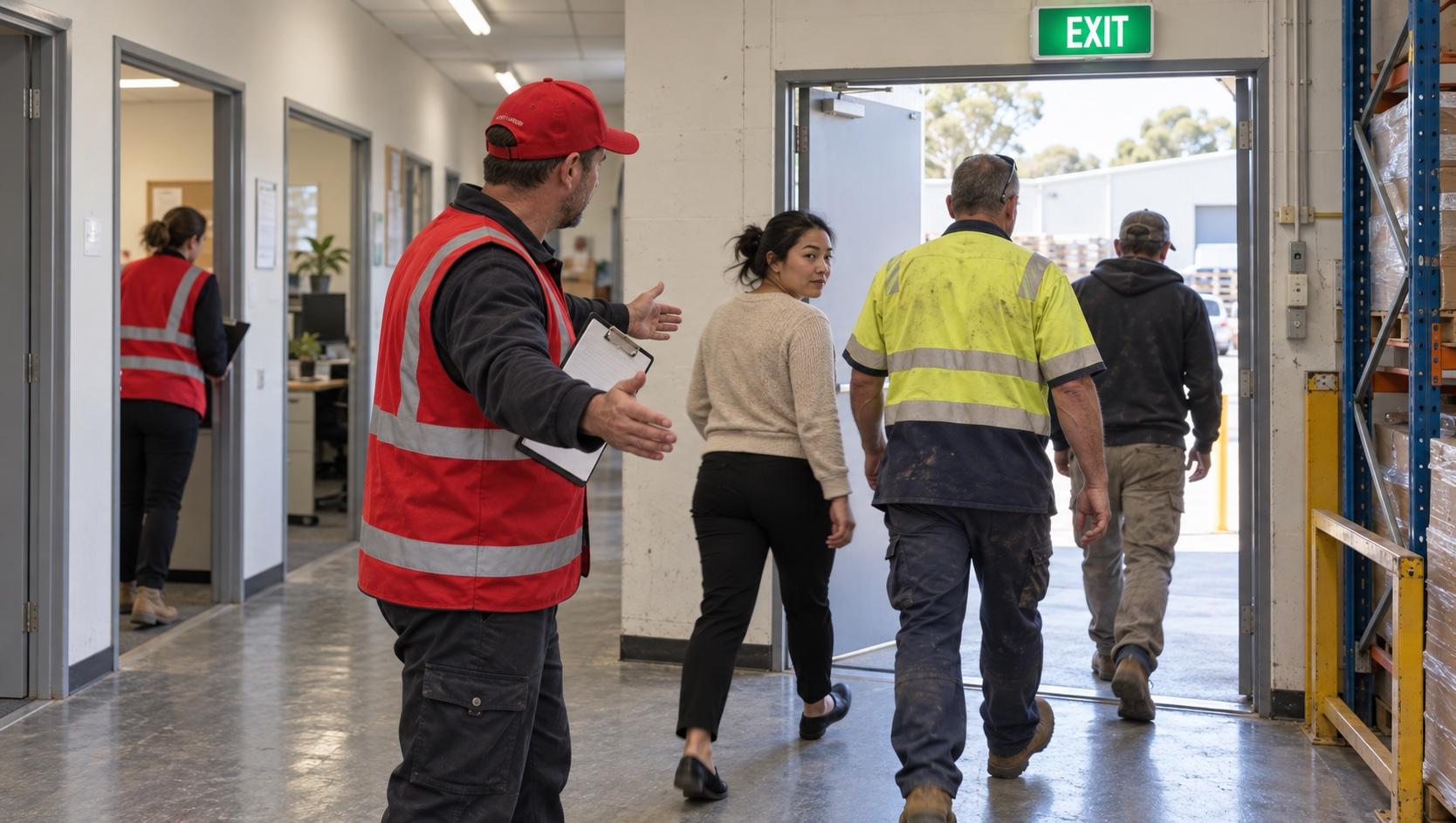
Fire Warden is for people who carry out an evacuation. Chief Fire Warden is for the person who leads the emergency response. Fire Extinguisher is separate training for safely confining a small emergency.
A new chief warden completes Fire Warden before Chief Fire Warden.
All three are practical, nationally recognised courses. Each one gives you the skills and the confidence to know exactly what to do when the alarm sounds.
Is a fire warden a legal requirement?
Not by name. No law says every workplace must have a fire warden. But it is a legal requirement for every workplace to have an emergency plan.
Under the model WHS laws, the business must:
- make an emergency plan, including an effective response to emergencies
- test the plan and keep it up to date
- arrange training for workers on the plan and its procedures
- put the plan into action in an emergency
Victoria covers emergency planning through employers' general duties under its own OHS laws, and WorkSafe Victoria recommends appointing, training and equipping wardens.
Wardens are how many workplaces carry out their plan. The Australian Standard AS 3745, Planning for emergencies in facilities, sets out a team of wardens led by a chief warden. It is a standard, not a law, but it is the accepted benchmark for workplace emergency planning. It also recommends that wardens refresh their skills at least every 6 months.
If your workplace has appointed you as a warden, warden training helps it meet its duty to train you on its emergency plan.
Why step up as a fire warden?
Become one of the people your workplace can't do without. Every workplace needs an emergency plan, and someone has to carry it out. Trained wardens fill a role the business has to fill. That makes you a valued, essential part of the team, not just another name on the roster.
Stand out to your employer. Putting your hand up for extra responsibility gets noticed. A warden role on your record shows you can be trusted with people's safety, and that can strengthen your case at review time, when you ask for a pay rise, or when you go for a promotion.
Lead when it matters most. In an emergency, people look for someone who knows what to do. As a warden, that is you. You know the plan, the exits and how to get everyone out safely, and you keep people calm while you do it.
Open the door to the next role. Fire Warden is the first step to becoming a chief warden and leading the whole emergency response. Every workplace with an emergency team needs someone in that seat.
Take it with you. Your Statement of Attainment is nationally recognised. Change jobs or move interstate, and you arrive with a skill your next employer also needs.
Use it at home too. Knowing your exits, staying calm and checking that everyone is out are just as useful at home, in a hotel or anywhere else you spend time.
Compare the roles
Your appointment tells you where to start. Find your role in the table and you have your course.
| Your workplace role | Course to choose |
|---|---|
| Floor, area or deputy warden | Fire Warden |
| Chief or deputy chief warden | Fire Warden, then Chief Fire Warden |
| Worker expected to use first-attack equipment | Fire Extinguisher |
Fire Warden carries out the plan
Fire Warden trains floor, area and deputy wardens. It covers preparing for an emergency, responding to alarms, helping people evacuate and following the workplace emergency plan.
You learn how to put your facility's emergency response procedures into action, respond to emergency signals and warnings, carry out safety practices and support the work that follows once the emergency is over.
The nationally recognised unit is PUAFER005 Operate as part of an emergency control organisation. There is no earlier course you need to complete.
It is the ideal first step for anyone who looks after the safety of the people and visitors in a building. It is also the foundation you build on if you step up to chief warden later.
Chief Fire Warden leads the response
Chief Fire Warden is for the person who coordinates the response. That can include directing the wardens, communicating with emergency services and closing the incident safely.
The course suits chief wardens, deputy chief wardens and communications officers. You learn to run emergency planning and training, take command of the facility response, and keep emergency services and management informed during and after an emergency.
The unit is PUAFER006 Lead an emergency control organisation. You must already hold the Fire Warden unit before taking this course, and you need to provide the Statement of Attainment as evidence.
Have it ready and you are set to take the lead.
Fire Extinguisher is separate
Fire Extinguisher covers first-attack equipment and small emergencies. It suits anyone who works in or occupies a building, including employees, contractors, students and residents.
You practise assessing an emergency, using initial response equipment such as fire extinguishers, and reporting what happened afterwards. It sits alongside the warden courses as its own hands-on skill.
Your workplace emergency plan decides who needs this extra skill. A warden can hold both, and each one adds something different to your workplace's emergency team.
What your workplace needs
The business is responsible for its emergency plan and worker training. Your appointment—warden, chief warden or first-attack responder—is the best starting point for choosing the course.
Every course mixes classroom and practical activities with videos and an end-of-day assessment. You learn by doing, so you leave ready to act.
All 3 courses are nationally recognised and are delivered and issued by Training Aid Australia (RTO 91411).
Next step
If you have been appointed a warden, start with Fire Warden. Chief wardens then continue to Chief Fire Warden.
Add Fire Extinguisher when your workplace wants first-attack training as well.
Pick a date that suits you and become the person your workplace can count on in an emergency.
Sources
- Safe Work Australia — Emergency plans and proceduresThe employer duty to have an emergency plan and to arrange training for workers on it
- Safe Work Australia — Emergency plans: WHS duties'It is a legal requirement for every workplace to have an emergency plan', the business's duties and model WHS Regulation 43
- AS 3745 — Planning for emergencies in facilitiesThe emergency control organisation structure and the 6-monthly skills-retention recommendation
- training.gov.au — PUAFER005, PUAFER006 and PUAFER008Unit codes and official titles